
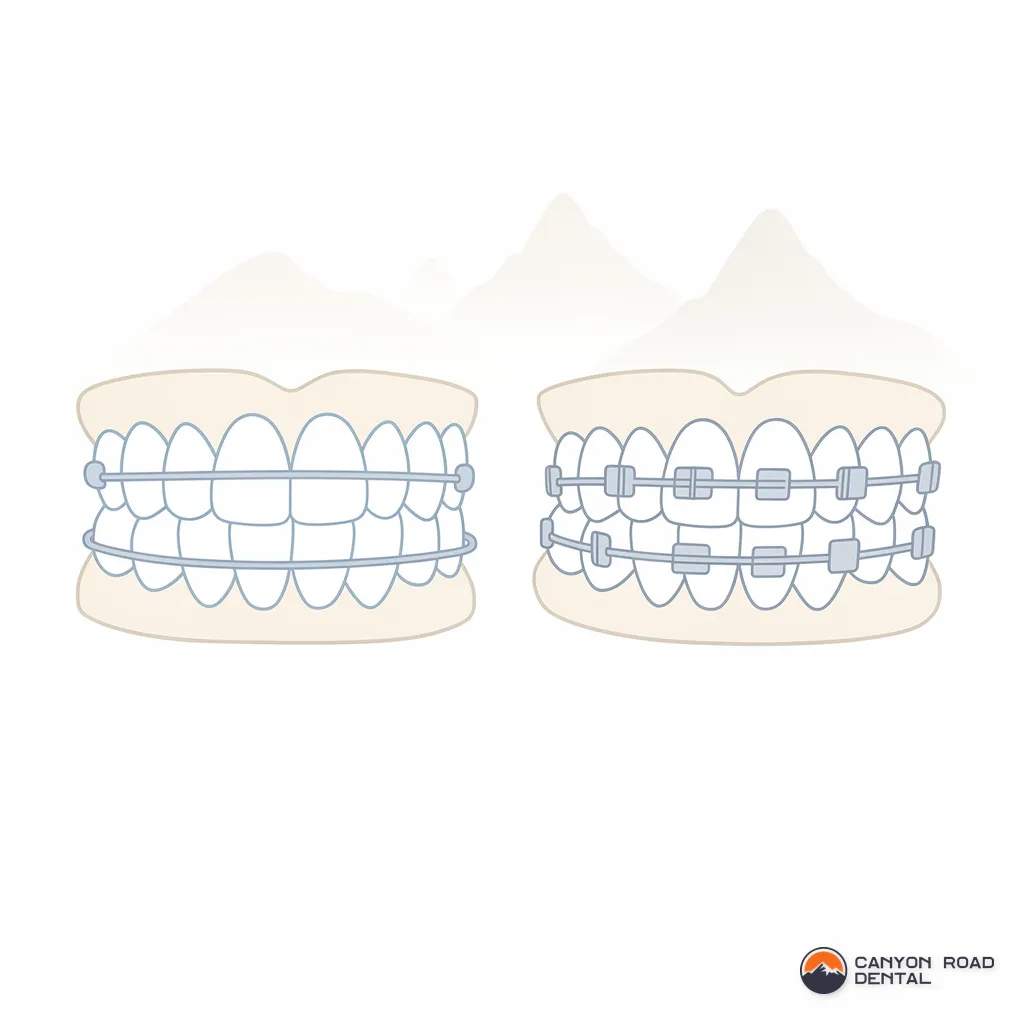
When it comes to invisalign vs braces, invisalign offers clear, removable aligners ideal for mild-to-moderate cases. Traditional braces can address a range of alignment issues. Canyon Road Dental in Provo, UT evaluates each patient’s bite, spacing, and lifestyle needs to recommend the most effective treatment, delivering straighter teeth through personalized orthodontic care.
Straighter smiles: Canyon Road Dental in Provo offers structured consultations comparing Invisalign and traditional braces, helping teens and adults choose confidently. Located near Brigham Young University, our team walks patients through clinical and lifestyle differences. They achieve their desired smile without unnecessary metal in their mouth.
Invisalign and traditional braces both straighten teeth effectively, but Canyon Road Dental in Provo, Utah, near Brigham Young University, offers structured consultations comparing both options. Invisalign uses clear, removable aligners for discreet treatment, while traditional braces use fixed brackets and wires. Your lifestyle, budget, and dental needs determine which option fits your smile goals best.
Key Takeaways
Invisalign and traditional braces both deliver straighter, more beautiful smiles through different treatment approaches.
Canyon Road Dental serves Provo patients near Brigham Young University with comprehensive orthodontic education resources.
Clear aligners offer a discreet alternative to traditional braces for teens and adults seeking straighter teeth.
Custom-made removable aligners allow patients to achieve their desired smile with personalized treatment plans.
Why Are Provo Patients Comparing Invisalign and Braces?
Straightening options have multiplied, and Provo residents now weigh clear aligners against metal brackets before committing to treatment. Crooked teeth, overcrowded smiles, and other alignment issues no longer point to a single fix. Orthodontics has advanced enough that you can choose a path that fits your lifestyle, not just your bite.
Canyon Road Dental, based in Provo, UT, gives you a local resource for sorting through these choices. You don’t need to travel outside Utah County to get clear, professional guidance on Invisalign vs braces. Because the practice is headquartered right here in Provo, residents throughout the county can compare clear aligners against traditional metal braces without scheduling a long drive across the valley.
Who benefits most from comparing these two options?
BYU students juggling class schedules, teens balancing sports and social life, and parents managing a household all have different priorities. A Provo location makes it easier for each of these groups to explore straightening options that match their daily routines. Convenience matters when you’re deciding between a treatment that’s barely visible and one that’s been a trusted standard for decades.
What should you weigh before choosing?
Consider these factors as you compare your options:
Visibility — clear aligners sit closer to invisible than metal brackets and wires
Lifestyle fit — removable trays versus fixed hardware changes how you eat, brush, and floss
Treatment complexity — some cases of overcrowding or misalignment respond better to one method than the other
Talking through these factors with a local provider helps you avoid guesswork and choose confidently.
How Do Invisalign and Traditional Braces Actually Work?
Pressure moves teeth, but each system delivers that pressure in a completely different way. Invisalign vs braces comes down to mechanics: one uses fixed metal hardware, the other uses removable plastic trays. Understanding this distinction helps you decide which approach fits your life in Provo, Utah.
Traditional bracesrely on metal brackets bonded directly to each tooth. Thin wires connect those brackets, threading through them like a track. Your orthodontist tightens these wires at scheduled visits, gradually coaxing teeth into alignment over time. The system stays on your teeth around the clock until treatment ends.
Invisaligntakes a different route entirely. Instead of brackets and wires, you wear a series of clear, custom-fitted aligner trays. Each tray nudges your teeth slightly closer to their final position. You switch to a new one as your smile progresses.
Which System Applies Pressure More Consistently?
Braces apply constant, unrelenting pressure since the wire never comes off. Invisalign applies pressure in stages, with each new tray taking over where the last one left off. Both methods work toward the same goal—straighter teeth—just through different daily experiences.
Canyon Road Dental, based in Provo, UT, walks you through these mechanics before you commit to either path. During your consultation, the team explains exactly how your teeth will move, tray by tray or adjustment by adjustment. That clarity matters, especially for BYU students and busy parents juggling tight schedules.
Key mechanical differences:
Braces: fixed brackets, wires tightened in-office
Invisalign: removable trays, changed at home
Braces: pressure applied continuously
Invisalign: pressure applied in incremental stages
Knowing how each system works is the first step toward choosing the right one for your smile.
Which Option Fits a Busy Provo Lifestyle?
Removable aligners win for packed schedules; fixed braces demand no daily decisions at all. Between BYU classes, part-time jobs, and family commitments, your calendar in Provo probably doesn’t leave room for extra dental drama. The right choice comes down to how much control you want over your own treatment day to day.
Invisalign vs braces creates a real fork in the road for convenience. Traditional braces stay bonded to your teeth for the full course of treatment, which means zero maintenance decisions but also zero flexibility around meals, presentations, or date nights. Invisalign trays work differently. They’re removable, so you take them out to eat, study, or give a class presentation without metal catching the light.
Can you eat and study normally with aligners?
Yes. Because clear aligner trays are custom-made and removable, you pull them out for meals and pop them back in afterward. No food restrictions, no wire repairs between classes.
Do aligners fit around a student or work schedule?
Generally, yes. Removable trays adapt to irregular schedules better than fixed brackets, since you control when they’re in or out.
Here’s a quick side-by-side for busy Utah County patients:
Canyon Road Dental, located in Provo, UT, helps BYU students and Utah County families weigh these trade-offs against real class schedules and family calendars. Whether your week revolves around exams, shift work, or school pickups, a Provo-based team can match the treatment to your actual routine, not just your smile goals.
Is Invisalign Right for Every Provo Smile?
Not every smile fits the same mold, but most Provo patients qualify for clear aligner treatment after a proper evaluation. Straight teeth used to mean one option: metal wire and brackets. Today’s orthodontic landscape looks different. You can pursue a straighter smile without ever worrying about visible metal in your mouth again.
Canyon Road Dental, located in Provo, UT, evaluates your specific smile goals to recommend the best treatment path. That review matters because Invisalign vs braces isn’t a one-size-fits-all decision. Your bite, your daily habits, and the complexity of your case all factor into which treatment actually delivers results.
How Does Invisalign Compare to Braces for Comfort?
Clear aligners stand out for looking natural while feeling gentler on your mouth. Aligners are described as aesthetically appealing and notably more comfortable than braces built from other materials. If you’re a BYU student heading to class or a parent managing a packed schedule, that comfort difference shows up daily, not just at checkups.
Does Case Complexity Change Which Option Works Best?
Yes. As a Provo, UT provider, Canyon Road Dental factors in how complex your case is before advising on either option. Some misalignments respond well to aligners; others need the fixed control that traditional brackets provide.
Consider these factors before you decide:
Severity of misalignment – mild to moderate cases often suit aligners well
Daily discipline – aligners require consistent wear to stay on track
Comfort priorities – smoother materials mean less irritation for many patients
Visibility concerns – students and professionals often prefer a discreet option
A personalized consultation remains the clearest way to know which path fits your smile.
What Should Provo Patients Do Next?
Schedule a consultation. That single step turns the Invisalign vs braces question from guesswork into a clear, personalized plan. A structured consultation walks you through the clinical differences—like how each system moves teeth—and the lifestyle differences, such as diet restrictions or cleaning routines, before you commit to either path.
Canyon Road Dental, based in Provo, UT, invites you to book that comparison visit and get real answers instead of internet speculation. The practice serves as a straightforward option for BYU students, working adults, and parents across the Provo area who want a straighter smile without months of uncertainty.
How do I know which option fits my life in Provo?
Start by listing your daily habits: sports, work meetings, social events, and how much visibility bothers you. A consultation compares those factors against each system’s requirements, so you leave with a decision built on your actual routine, not a generic recommendation.
Being centered in Provo also means convenience extends beyond the city limits. Neighbors in Orem, Springville, and Spanish Fork can reach the practice without a long drive, making follow-up visits and adjustments far easier to keep on schedule.
Before your visit, consider bringing:
A list of questions about treatment length and daily wear time
Notes on past dental work, including previous orthodontic treatment
Your schedule constraints, so the consultation can address real-world fit
Provo’s location advantage matters here. With the practice positioned centrally in Utah County, reaching a straighter smile through either treatment path becomes a matter of scheduling one visit and getting a clear, evidence-based plan.
FAQ
What is the main difference between Invisalign and traditional braces?
Invisalign uses clear, removable aligners for discreet treatment. Traditional braces use fixed brackets and wires bonded directly to each tooth. The mechanics differ, but both systems apply pressure to move teeth into alignment.
Where can Provo residents get help choosing between Invisalign and braces?
Canyon Road Dental in Provo, UT, near Brigham Young University, offers structured consultations comparing both options. Patients throughout Utah County get local, professional guidance without traveling across the valley.
What factors should patients consider when choosing a straightening option?
Patients should weigh visibility, lifestyle fit, and treatment complexity. Removable trays versus fixed hardware changes daily routines like eating and brushing. Some cases of overcrowding or misalignment respond better to one method than the other.
Conclusion
In closing, the choice between Invisalign and traditional braces depends on your lifestyle, budget, and orthodontic needs. Both options deliver effective results when guided by an experienced dental professional committed to your comfort and success. At Canyon Road Dental in Provo, our team evaluates your unique situation to recommend the treatment that aligns with your goals, ensuring you achieve the confident smile you deserve.